How Torch-Spyre works: an out-of-tree PyTorch backend
Summary. Torch-Spyre is an out-of-tree PyTorch backend for the IBM Spyre dataflow accelerator. It does not fork PyTorch. It uses the extension points that PyTorch already provides: PrivateUse1, the TorchInductor backend API, and custom tensor layouts. Torch-Spyre runs model inference on Spyre today through IBM’s Foundation Model Stack (FMS). Granite 3.3 8B is one of the models we run in production. We are close to running an unmodified HuggingFace model end to end with just
model.to("spyre")andtorch.compile. This page describes how the integration was built.
This page is written for new team members, hardware collaborators, and anyone who wants to understand how Torch-Spyre integrates with PyTorch as an out-of-tree backend. It walks through the four main design challenges we hit and the PyTorch extension mechanism that addressed each one. API names, op lists, and pass hooks reflect the state of the codebase at the time of writing. For current state, see the rest of this documentation and the repo.
A device with a different execution model from a GPU
The code below runs Granite 3.3 8B on Spyre today through IBM’s Foundation Model Stack (FMS).
import torch
from fms.models import get_model

model = get_model("granite", "3.3-8b-instruct", device_type="spyre")
compiled = torch.compile(model, backend="spyre")
output = compiled(input_ids.to("spyre"))
FMS wraps the model definition. Everything below that line is standard PyTorch: .to("spyre"),
torch.compile, and a device string. We are working toward the same snippet with a stock
HuggingFace AutoModelForCausalLM in place of get_model, with no modifications.
from transformers import AutoModelForCausalLM
model = AutoModelForCausalLM.from_pretrained("ibm-granite/granite-3.3-8b-instruct")
model = model.to("spyre")
compiled = torch.compile(model)
Closing the remaining gap (op coverage, dynamic shapes, KV-cache handling) is active work. The rest of this post explains the extension points that got us this far.
The IBM Spyre Accelerator does not operate the way PyTorch assumes hardware operates. Spyre is a 32-core dataflow processor that delivers over 300 TOPS within a 75W PCIe card. It is designed for enterprise AI inference on IBM Z and Power systems. Its design priorities are deterministic latency, hardware-level security isolation, and power efficiency. Meeting those priorities required an architecture that differs from a GPU in several ways.
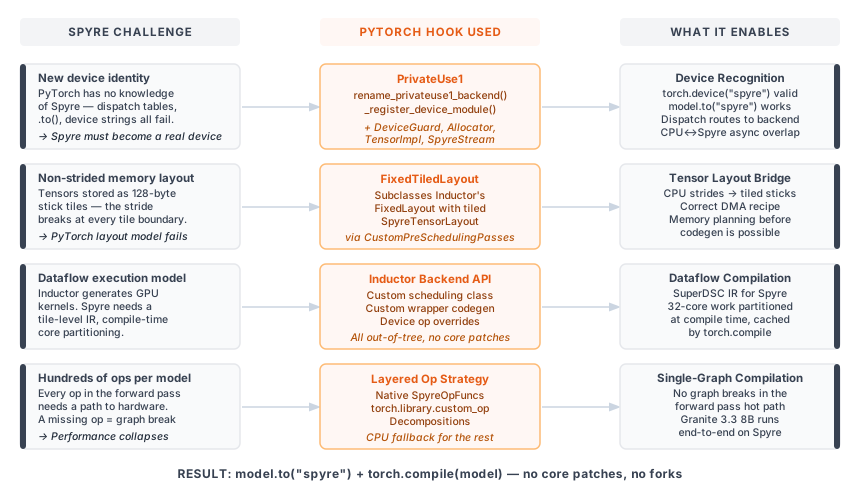
Figure 0: The four challenges we address in this post, with the PyTorch extensibility mechanism that handled each one.
From research to production. Since this work began, Spyre has shipped in two production systems: as the AI accelerator in IBM z17 mainframes (which support up to 48 Spyre cards, each delivering 300+ TOPS) and in IBM Power11 servers via a 75W PCIe gen5 x16 card with 128 GB of LPDDR5 memory. The Torch-Spyre integration described in this post targets that PCIe card configuration. [IBM Z press release] · [IBM Power11 press release] · [IBM Research blog]
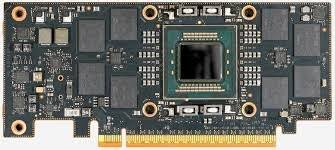
The IBM Spyre™ Accelerator. It delivers over 300 TOPS within a 75W PCIe gen5 x16 form factor and ships with 128 GB of LPDDR5. Photo: IBM.
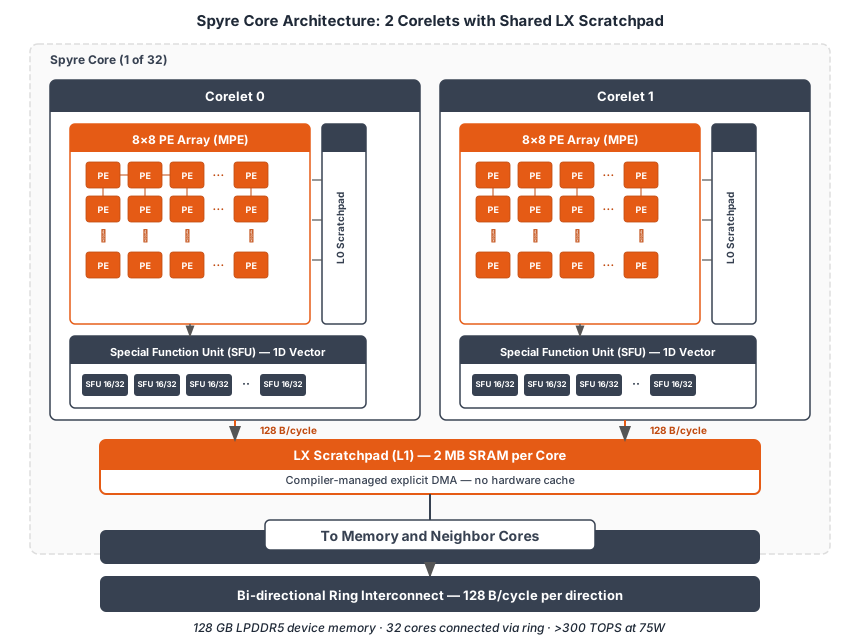
Figure 1a: Each Spyre core contains two corelets (each with an 8×8 systolic Processing Element (PE) array and a 1D Special Function (SFU) vector unit) sharing a 2 MB LX scratchpad (SRAM). Cores communicate via a bi-directional ring interconnect at 128 B/cycle per direction. Architecture derived from the RaPiD AI accelerator (Venkataramani et al., ISCA 2021).
Dataflow execution instead of SIMT. On a GPU, thousands of threads execute the same instruction on different data in lock-step. This is the Single Instruction, Multiple Threads (SIMT) model. SIMT works well when arithmetic intensity is high and memory access patterns are regular. The decode phase of LLM inference has the opposite characteristics. It is memory-bandwidth bound, execution is sequential across layers, and attention memory access patterns can be irregular. Spyre addresses this with a dataflow execution model. Operations form a directed acyclic graph. Data flows through a chain of operators, and the hardware is configured per operation at compile time. Because the execution schedule is fixed ahead of time, latency is deterministic. There is no thread scheduling jitter and no dynamic dispatch overhead. There are no warps, no thread blocks, and no shared memory in the CUDA sense.
Tiled memory instead of strided memory. The tiled layout was chosen to match the hardware.
The 128-byte aligned sticks of 64 fp16 elements (a constant we call BYTES_IN_STICK=128) match
the natural granularity of data transfers between DDR and scratchpad on the internal datapaths.
This lets the hardware load a full stick of contiguous elements in a single transfer, so each
memory access delivers as much useful data as possible. The tradeoff is that PyTorch’s
(size, stride) model cannot express this layout. A 2D tensor stored as a tiled 3D structure has
no single integer stride for the second dimension. The stride jumps at every tile boundary.
Explicit data movement instead of hardware caches. Implicit caches introduce non-determinism. Eviction policy, cache pressure from other workloads, and prefetcher heuristics all affect latency in ways that the software stack cannot predict or control. Spyre’s 2 MB programmable scratchpad per core removes that uncertainty. The compiler decides exactly what lives in Static Random-Access Memory (SRAM) at each point in the computation. Data moves from Spyre’s 128 GB LPDDR5 device memory into the 2 MB per-core SRAM scratchpad only when the compiler has scheduled that transfer. This is what allows Spyre to guarantee latency bounds that GPU-class hardware typically cannot. The cost is that every data transfer must be deliberate. The Torch-Spyre backend is responsible for allocating tensors to the scratchpad. The backend compiler (Deeptools) handles the actual scheduling of data movement between DDR and the scratchpad, including double-buffering.
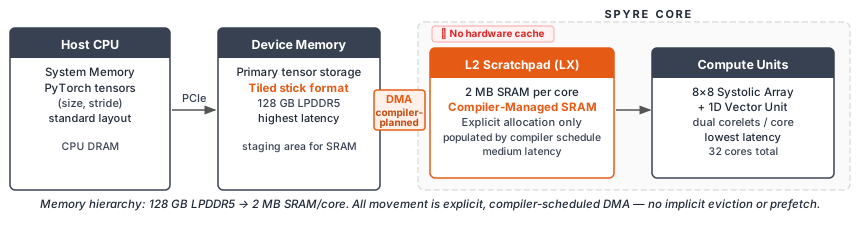
Figure 1: All data movement is planned by the compiler through explicit load and store instructions. Data moves between 128 GB of LPDDR5 and a 2 MB per-core SRAM scratchpad. Spyre has no hardware cache.
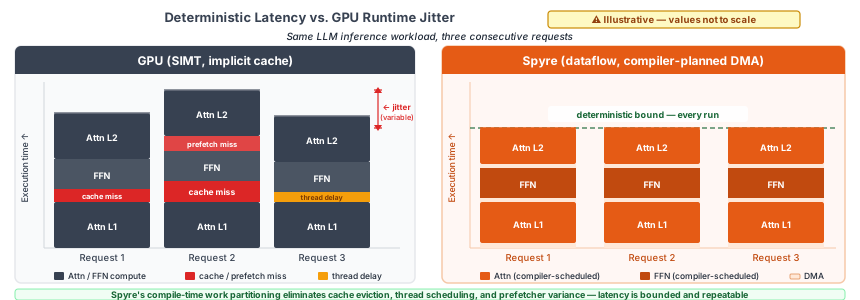
Figure 1b (illustrative). GPU execution is subject to thread scheduling jitter, cache evictions, and dynamic dispatch overhead. The compiler-planned dataflow on Spyre produces a flat, deterministic latency profile for the same model. Latency values in the figure are illustrative. Exact results depend on the model and batch configuration.
Challenge 1: making PyTorch recognize a new device
PyTorch reserves a mechanism called PrivateUse1 for out-of-tree backends. We based our implementation on OpenReg, PyTorch’s reference implementation for out-of-tree device registration. Two lines of Python rename the device.
torch.utils.rename_privateuse1_backend("spyre")
torch._register_device_module("spyre", make_spyre_module())
After that, "spyre" is a first-class device name. Those two calls register the dispatch tables,
the .to("spyre") method on tensors and modules, and device string parsing.
Renaming the device is only the entry point. We also had to implement the C++ infrastructure
that gives the device its actual behavior. That infrastructure includes a device guard that
tracks context through thread-local storage, a custom allocator that wraps the Spyre flex memory
system without exposing raw pointers (a security requirement on IBM Z), a custom TensorImpl
that carries tiled memory metadata alongside the standard PyTorch layout, a hooks interface that
reports device availability to the PyTorch runtime, and SpyreStream, which matches
torch.cuda.Stream semantics so that asynchronous execution works as users expect.
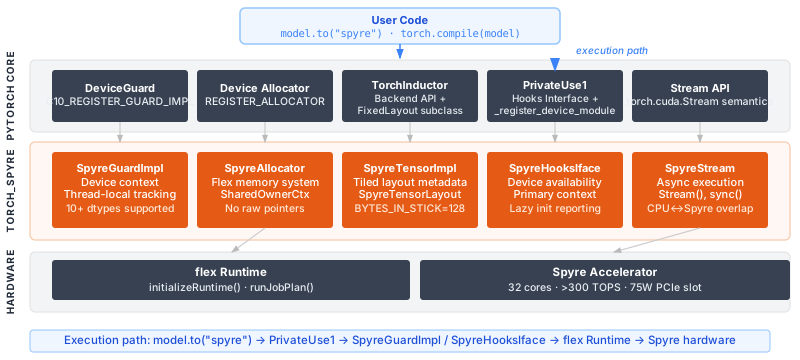
Figure 2: All Torch-Spyre components are out-of-tree and the PyTorch core is unmodified. The
blue path shows how model.to("spyre") flows through the PrivateUse1 hooks to the hardware.
Initialization is lazy. Importing torch_spyre registers the device name and module, but the
C++ runtime does not start until the device is used for the first time.
PrivateUse1 covers most of what an out-of-tree backend needs. The dispatch infrastructure that
integrates GPUs with PyTorch is available to out-of-tree backends through the same pathway. The
basic extension points are well documented. torch.accelerator and OpenReg give a clear starting
point. The deeper extension points (scheduler passes and codegen hooks) are not well documented.
For those, we read the Ascend NPU and Intel GPU source code to understand the patterns.
Challenge 2: teaching PyTorch a memory layout it had never seen
After the device was registered, PyTorch knew that Spyre existed. The harder problem was tensors. Tensors on Spyre are not laid out the way PyTorch expects.
Consider a standard (1024, 256) fp16 tensor. In PyTorch this has strides (256, 1). Element
[i, j] lives at offset i × 256 + j. This model works for row-major, column-major, and
transposed views. It works for almost everything in the GPU world.
On Spyre, the same tensor is physically stored as four tiles of 64-element sticks. Each stick is
128 bytes and holds 64 fp16 elements. The layout is organized as if the tensor had shape
(4, 1024, 64). The element at position [i, 63] and the element at [i, 64] are not separated
by a stride of 1. They sit in different tiles with a jump between them. There is no single
integer stride that describes this layout, and the current PyTorch layout model cannot represent
it.
We needed a new abstraction. We built FixedTiledLayout as a subclass of the TorchInductor
FixedLayout class. FixedTiledLayout augments the standard host-side description with a
SpyreTensorLayout descriptor. The descriptor carries the tiled device-side size, a stride map
from host dimensions to device dimensions, and the device dtype. This is sufficient to describe
how data is stored on the device and how to move it between the host and device representations.
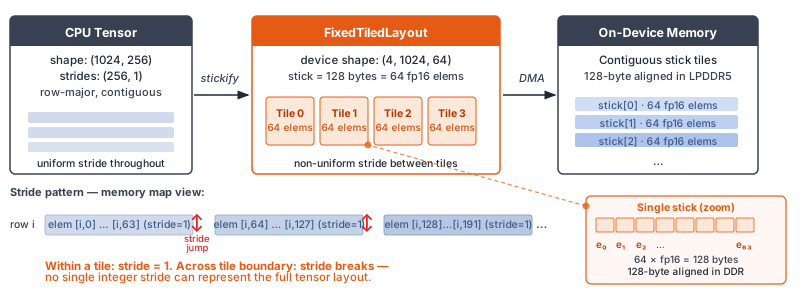
Figure 3: A (1024, 256) tensor becomes a (4, 1024, 64) tiled structure on Spyre. The stride breaks at every tile boundary, so the layout cannot be expressed as a single integer stride.
The harder question was where in the Inductor pipeline we should propagate these layouts. We
tried propagating through Dynamo using FakeTensor. That approach was too invasive and too
fragile to maintain out-of-tree. We then considered deferring propagation to the final codegen
stage, as Triton does. That would have been too late, because we need layout information for
memory planning and multi-core work division before code generation begins.
The right place turned out to be the Inductor scheduler phase, using custom pass hooks. We run two kinds of passes. The first set runs over the FX graph before it is lowered to the Inductor LoopLevel IR. The second set runs over the LoopLevel IR itself before codegen.
Layout propagation runs on the LoopLevel IR. A function called
propagate_spyre_tensor_layouts() traverses the scheduler graph and converts the standard
FixedLayout of each tensor into our FixedTiledLayout. The conversion rules depend on the
operator type. Pointwise ops inherit the layout of their inputs. Reductions, and matmul in
particular, need special handling because the stick dimension of the output is related to the
contracted dimension of the input. External kernels, which include custom ops and fallbacks,
receive a safe default tiled layout.
Core work division also runs on the LoopLevel IR, after layout propagation. Two passes
cooperate. span_reduction() identifies which iteration dimensions can be parallelized across
cores and how the span of each reduction partitions. work_distribution() then assigns those
spans to the 32 cores and embeds the plan into the IR for codegen to consume.
One caveat is worth mentioning. The scheduler pass hooks are underscore-prefixed private APIs. They have been stable for us, but they can change between PyTorch releases without notice. We plan for occasional breakage.
FixedTiledLayout is designed to be reusable beyond Spyre. Any accelerator with non-strided,
block-aligned memory, such as a systolic array chip, an FPGA design, or scratchpad-based
inference silicon, faces the same mismatch with the PyTorch stride model. We would like to see
this become a standard Inductor extension point.
Challenge 3: extending TorchInductor for dataflow compilation
With a registered device and a way to express tiled tensors, the last challenge was code generation. TorchInductor was designed with GPUs in mind. Its scheduler, codegen, and backend assume thread blocks, dynamic dispatch, and Triton kernels. Spyre operates differently at every level. Work is partitioned across cores at compile time instead of being dispatched by hardware at runtime. The output is a tile-level IR instead of a GPU kernel. No one had extended Inductor for this kind of architecture before.
The Inductor backend registration API is more composable than we expected. We provided our own scheduling class, wrapper codegen, and device op overrides. All three are registered at import time, and all three live out-of-tree. Those three registrations were enough to swap in a completely different execution model without modifying the Inductor core. Our backend currently produces SuperDSC, a JSON-based IR that describes tile-level compute graphs for the 32 cores of Spyre. SuperDSC is an interim format. Its successor, KTIR, is discussed later in this page.
The most unusual piece in the pipeline is compile-time work division. On a GPU, the hardware
scheduler distributes thread blocks at runtime. On Spyre, the compiler makes that decision
statically. The compiler partitions each iteration dimension across 32 cores, distributes sticks
evenly across cores, respects per-core memory limits, and embeds the resulting plan directly into
the SuperDSC IR. The result is a self-contained compiled artifact that is cached through the
standard torch.compile caching system.
The full compilation path, from the torch.compile entry point through the Spyre-specific
passes to the device binary, is shown in Figure 4.
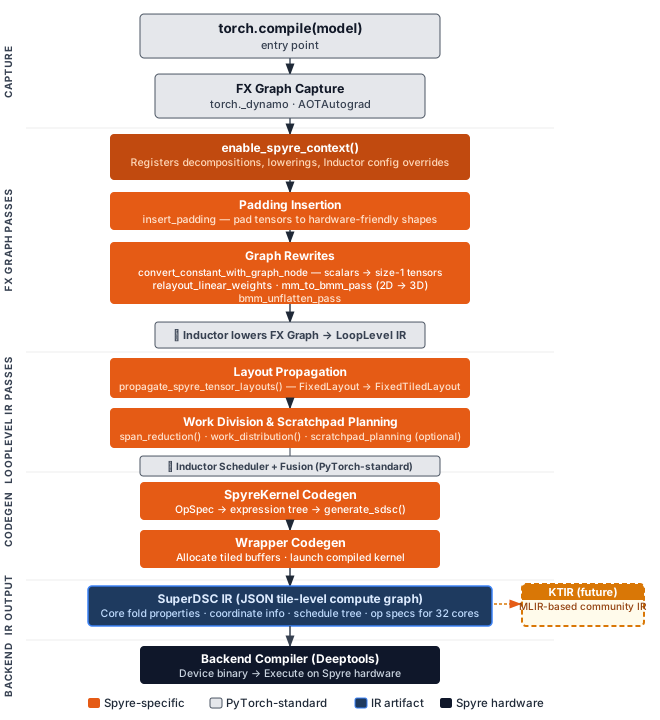
Figure 4: The Spyre-specific passes (orange) operate on two IR levels. The first set runs on the FX Graph before Inductor lowering. The second set runs on the LoopLevel IR before codegen. The gray boxes mark PyTorch-standard stages. The SuperDSC IR (blue) is the compiled artifact. KTIR is the planned replacement.
The exact timing of these passes is still in flux. We keep finding cleaner extension points and moving passes around. What does not change is what each pass does: layout propagation, work division, and scratchpad planning.
The compilation pipeline uses the standard PyTorch components without modification. These are the FX graph capture, AOTAutograd, and the Inductor scheduler. The Spyre-specific passes were created through the published extension APIs. We did not fork PyTorch. We do still monkey-patch a few internal APIs where the extension points are incomplete. Those patches cover dtype maps, fusion patterns, and compile_fx wrapping. The rest of the architecture is out-of-tree.
SuperDSC: the Spyre tile-level intermediate representation
A GPU backend typically produces Triton kernels or CUDA templates and library calls. Torch-Spyre produces SuperDSC (Super Design Space Config) instead. SuperDSC is a JSON-based intermediate representation that describes the full tile-level compute graph for the 32 cores of Spyre. Understanding SuperDSC is required to understand how the Torch-Spyre compiler backend differs from a GPU backend.
What SuperDSC encodes
SuperDSC is not a kernel. It is a self-contained, compiled artifact that describes everything
the Spyre hardware needs to execute a single scheduled operation deterministically. The top-level
structure contains core fold properties, work-slice mappings, and a per-core execution schedule.
A dscs_ array holds one or more DesignSpaceConfig entries. Each entry is a complete
description of one compute configuration, and contains the following elements.
Core fold properties (
coreFoldProp_,numWkSlicesPerDim_,coreIdToWkSlice_): how to divide the iteration space across 32 cores. For a tensor of shape(1024, 256), this encodes how many rows each core processes. The encoding gives each core an equal number of sticks and keeps each core within its addressable device memory limit.Tensor descriptors (
labeledDs_,primaryDsInfo_): for each tensor argument, the tiling structure define which dimensions are stick dimensions, how the host-side shape maps to device-side tiles, memory residency (HBM vs. LX scratchpad), data format, and which dimensions each tensor iterates over fully vs. which are summed over (contracted) as in the K dimension of a matmul.Schedule tree (
scheduleTree_): a list of allocate nodes (one per tensor) that specify memory placement (HBM or LX scratchpad), dimension ordering, per-core start addresses via fold mappings, and coordinate information encoding how each dimension is split across cores with affine transformations.Data staging (
dataStageParam_): per-core dimension sizes for steady-state and epilogue passes, describing how data is partitioned for transfer into scratchpad.Compute operations (
computeOp_): one entry per operation, encoding the execution unit (PT or SFP), operation name, data format, fidelity, and the input/output tensor references fromlabeledDs_.
Folding is a central concept in SuperDSC. A single parameterized artifact can represent multiple
execution variants across time steps and cores without recompilation. Fold properties use affine
transformations (alpha * index + beta) to compute per-core coordinates and addresses. One JSON
file describes the behavior of all 32 cores compactly instead of duplicating the description for
each core.
The codegen pipeline
Three components cooperate to produce a SuperDSC artifact for each scheduled node.
SpyreKernelcollects the iteration space from the scheduler and builds an RValue AST (Abstract Syntax Tree of read-side expressions) representing the computation with node types likeTensorAccess,PointwiseOp,ReductionOp, andConstant. Leaves are tensor reads or constants; internal nodes are operations. This captures the mathematical structure in a form the codegen can walk through.OpSpecpackages the kernel’s output into a structured descriptor: the operation name, the iteration space encoded as SymPy symbolic math expressions (which Inductor uses throughout for symbolic shape reasoning), the tensor arguments annotated with device coordinates (tile index, intra-stick offset), and any auxiliary information like constants or dtype conversion rules.generate_sdsc()takes theOpSpecand emits the final JSON IR. This is where symbolic expressions are resolved to concrete loop bounds, tiling parameters are expanded, and the schedule tree is assembled. The output is written to JSON files (e.g.,sdsc_0.json) that the Spyre backend compiler (Deeptools) consumes to produce a device binary.
Multi-core work division
Two passes run after layout propagation, and together they handle one of the decisions that
differs most from a GPU. That decision is the static partitioning of work across all 32 cores
at compile time. span_reduction() analyzes the iteration space of each reduction and determines
how its span can be split. work_distribution() then assigns those spans to cores.
The algorithm does four things. It identifies which iteration dimensions can be parallelized across cores. It uses a two-pass approach that first satisfies the minimum splits required per dimension (some dimensions have indivisible constraints) and then distributes the remaining cores by priority. It enforces that each core receives an equal number of sticks, so that there is no load imbalance. It validates that the data footprint for each core fits within the per-core addressable device memory range, which is a hardware address space constraint that is distinct from the 2 MB SRAM scratchpad.
The result is embedded directly in the SuperDSC IR. Each core knows exactly which slice of the iteration space it owns before the binary reaches the hardware. There is no runtime scheduler, no dynamic load balancing, and no speculation. This is what makes Spyre latency deterministic. Every aspect of execution is decided at compile time.
Example: SuperDSC for abs on a (4, 64) fp16 tensor with 2 cores
The following example shows what Torch-Spyre produces for torch.abs on a (4, 64) fp16 tensor
with 2 cores. The structural skeleton below shows the key decisions. The field names match the
actual JSON, and the values are simplified for readability. Inductor names each dimension of the
iteration space sequentially. c0 is the first dimension (rows), c1 is the second (columns),
and so on for higher-dimensional tensors.
{
  "abs": {
    "coreFoldProp_":    { "factor_": 2 },          // 2-core split
    "coreIdToWkSlice_": { "0": {"c0": 0},          // core 0 → rows 0–1
                          "1": {"c0": 1} },         // core 1 → rows 2–3
    "dscs_": [{
      "abs": {
        "N_":              {"c0_": 4, "c1_": 64},   // full iteration space
        "dataStageParam_": {"c0_": 2, "c1_": 64},   // per-core slice
        "labeledDs_":      ["Tensor0", "Tensor1"],   // both dsType "INPUT" (same layout)
        "scheduleTree_":   ["allocate Tensor0 @ core0:0, core1:256",
                            "allocate Tensor1 @ core0:512, core1:768"],
        "computeOp_":      "abs(Tensor0) → Tensor1 on PT unit"
      }
    }]
  }
}
Each core receives 2 rows of 64 elements, which is one stick per row. The dscs_ entry
contains the full description, including tensor descriptors, per-core memory addresses, and the
compute operation. The corelet and row fold fields appear in the full artifact as pass-through
constants (always factor 1) that the backend compiler requires. Torch-Spyre reasons only at core
granularity. (Note: the hbm field name in the JSON is a legacy label in the SuperDSC IR that
refers to device memory in general. The actual device memory on Spyre is LPDDR5, not HBM.)
Full SuperDSC JSON artifact (click to expand)
{
  "abs": {
    "coreFoldProp_": {"factor_": 2, "label_": "core"},
    "coreletFoldProp_": {"factor_": 1, "label_": "corelet"},
    "numCoresUsed_": 2,
    "numWkSlicesPerDim_": {"c0": 2, "c1": 1},
    "coreIdToWkSlice_": {
      "0": {"c0": 0, "c1": 0},
      "1": {"c0": 1, "c1": 0}
    },
    "dscs_": [{
      "abs": {
        "numCoresUsed_": 2,
        "coreIdsUsed_": [0, 1],
        "N_": {"name_": "n", "c0_": 4, "c1_": 64},
        "dataStageParam_": {
          "0": {
            "ss_": {"name_": "core", "c0_": 2, "c1_": 64},
            "el_": {"name_": "core", "c0_": 2, "c1_": 64}
          }
        },
        "primaryDsInfo_": {
          "INPUT": {
            "layoutDimOrder_": ["c0", "c1"],
            "stickDimOrder_": ["c1"],
            "stickSize_": [64]
          }
        },
        "labeledDs_": [
          {
            "ldsIdx_": 0, "dsName_": "Tensor0", "dsType_": "INPUT",
            "scale_": [1, 1], "wordLength": 2,
            "dataFormat_": "SEN169_FP16",
            "memOrg_": {"hbm": {"isPresent": 1}, "lx": {"isPresent": 1}}
          },
          {
            "ldsIdx_": 1, "dsName_": "Tensor1", "dsType_": "INPUT",
            "scale_": [1, 1], "wordLength": 2,
            "dataFormat_": "SEN169_FP16",
            "memOrg_": {"hbm": {"isPresent": 1}, "lx": {"isPresent": 1}}
          }
        ],
        "scheduleTree_": [
          {
            "nodeType_": "allocate",
            "name_": "allocate-Tensor0_hbm",
            "ldsIdx_": 0,
            "component_": "hbm",
            "layoutDimOrder_": ["c0", "c1"],
            "startAddressCoreCorelet_": {
              "dim_prop_func": [{"Map": {}}, {"Const": {}}, {"Const": {}}],
              "dim_prop_attr": [
                {"factor_": 2, "label_": "core"},
                {"factor_": 1, "label_": "corelet"},
                {"factor_": 1, "label_": "time"}
              ],
              "data_": {"[0, 0, 0]": "0", "[1, 0, 0]": "256"}
            },
            "coordinates_": {
              "coordInfo": {
                "c0": {
                  "spatial": 3, "temporal": 0, "elemArr": 1,
                  "padding": "nopad",
                  "folds": {
                    "dim_prop_func": [
                      {"Affine": {"alpha_": 2, "beta_": 0}},
                      {"Affine": {"alpha_": 0, "beta_": 0}},
                      {"Affine": {"alpha_": 0, "beta_": 0}},
                      {"Affine": {"alpha_": 1, "beta_": 0}}
                    ],
                    "dim_prop_attr": [
                      {"factor_": 2, "label_": "core_fold"},
                      {"factor_": 1, "label_": "corelet_fold"},
                      {"factor_": 1, "label_": "row_fold"},
                      {"factor_": 2, "label_": "elem_arr_0"}
                    ]
                  }
                },
                "c1": {
                  "spatial": 3, "temporal": 0, "elemArr": 2,
                  "padding": "nopad",
                  "folds": {
                    "dim_prop_func": [
                      {"Affine": {"alpha_": 64, "beta_": 0}},
                      {"Affine": {"alpha_": 0, "beta_": 0}},
                      {"Affine": {"alpha_": 0, "beta_": 0}},
                      {"Affine": {"alpha_": 64, "beta_": 0}},
                      {"Affine": {"alpha_": 1, "beta_": 0}}
                    ],
                    "dim_prop_attr": [
                      {"factor_": 1, "label_": "core_fold"},
                      {"factor_": 1, "label_": "corelet_fold"},
                      {"factor_": 1, "label_": "row_fold"},
                      {"factor_": 1, "label_": "elem_arr_1"},
                      {"factor_": 64, "label_": "elem_arr_0"}
                    ]
                  }
                }
              }
            }
          },
          {
            "nodeType_": "allocate",
            "name_": "allocate-Tensor1_hbm",
            "ldsIdx_": 1,
            "component_": "hbm",
            "layoutDimOrder_": ["c0", "c1"],
            "startAddressCoreCorelet_": {
              "dim_prop_func": [{"Map": {}}, {"Const": {}}, {"Const": {}}],
              "dim_prop_attr": [
                {"factor_": 2, "label_": "core"},
                {"factor_": 1, "label_": "corelet"},
                {"factor_": 1, "label_": "time"}
              ],
              "data_": {"[0, 0, 0]": "512", "[1, 0, 0]": "768"}
            },
            "coordinates_": {
              "coordInfo": {
                "c0": {
                  "spatial": 3, "temporal": 0, "elemArr": 1,
                  "padding": "nopad",
                  "folds": {
                    "dim_prop_func": [
                      {"Affine": {"alpha_": 2, "beta_": 0}},
                      {"Affine": {"alpha_": 0, "beta_": 0}},
                      {"Affine": {"alpha_": 0, "beta_": 0}},
                      {"Affine": {"alpha_": 1, "beta_": 0}}
                    ],
                    "dim_prop_attr": [
                      {"factor_": 2, "label_": "core_fold"},
                      {"factor_": 1, "label_": "corelet_fold"},
                      {"factor_": 1, "label_": "row_fold"},
                      {"factor_": 2, "label_": "elem_arr_0"}
                    ]
                  }
                },
                "c1": {
                  "spatial": 3, "temporal": 0, "elemArr": 2,
                  "padding": "nopad",
                  "folds": {
                    "dim_prop_func": [
                      {"Affine": {"alpha_": 64, "beta_": 0}},
                      {"Affine": {"alpha_": 0, "beta_": 0}},
                      {"Affine": {"alpha_": 0, "beta_": 0}},
                      {"Affine": {"alpha_": 64, "beta_": 0}},
                      {"Affine": {"alpha_": 1, "beta_": 0}}
                    ],
                    "dim_prop_attr": [
                      {"factor_": 1, "label_": "core_fold"},
                      {"factor_": 1, "label_": "corelet_fold"},
                      {"factor_": 1, "label_": "row_fold"},
                      {"factor_": 1, "label_": "elem_arr_1"},
                      {"factor_": 64, "label_": "elem_arr_0"}
                    ]
                  }
                }
              }
            }
          }
        ],
        "computeOp_": [{
          "exUnit": "pt",
          "opFuncName": "abs",
          "attributes_": {"dataFormat_": "SEN169_FP16", "fidelity_": "regular"},
          "location": "Inner",
          "inputLabeledDs": ["Tensor0-idx0"],
          "outputLabeledDs": ["Tensor1-idx1"]
        }]
      }
    }]
  }
}
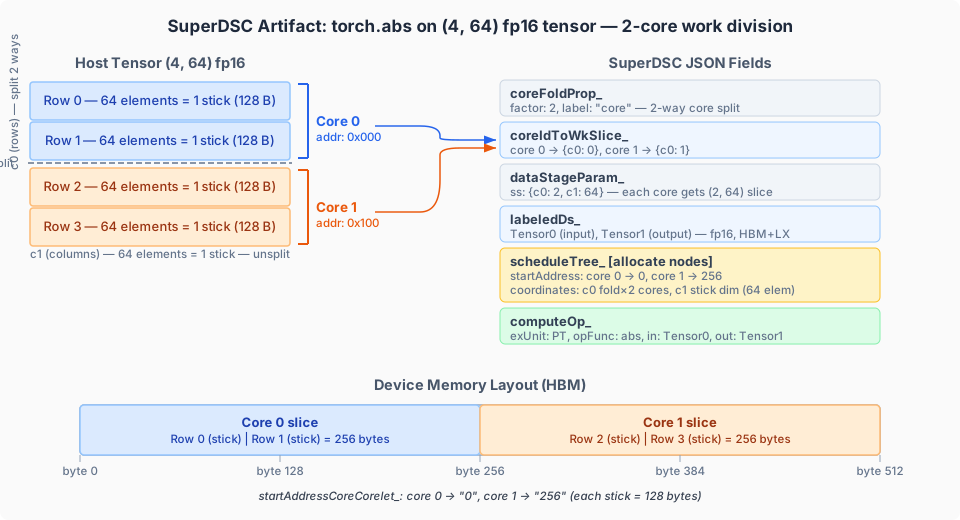
Figure 4b: A (4, 64) fp16 tensor split across 2 cores. There is one allocate node per tensor and one JSON artifact for both cores.
The table below shows what Torch-Spyre decides and what it encodes into SuperDSC for this example.
Decision |
SuperDSC Field |
Value |
|---|---|---|
Core count |
|
2 cores |
Row assignment |
|
Core 0 → rows 0–1, Core 1 → rows 2–3 |
Per-core slice |
|
(2, 64). Each core receives 2 rows with 1 stick each. |
Memory addresses |
|
Core 0 → byte 0, Core 1 → byte 256 (per tensor) |
Tensors |
|
Tensor0 (input) and Tensor1 (output), both fp16, both |
Operation |
|
|
One JSON file describes execution for both cores. The fold algebra, which includes the affine
transforms in coordinates_ and the Map function in startAddressCoreCorelet_, parameterizes
the artifact so that each core derives its own slice without a separate description. At 32
cores, this compactness matters.
Why JSON
We chose JSON as the wire format for SuperDSC because we needed to read and diff these
artifacts constantly during development. JSON is also straightforward to cache through the
torch.compile artifact system. When an operation produced wrong results on a specific core
layout, opening the artifact in a text editor and inspecting the address mapping for that core
was often the fastest way to diagnose the problem.
From SuperDSC to KTIR
SuperDSC was designed to get Torch-Spyre working quickly while emitting a pragmatic IR that matches the Spyre hardware model closely. We are transitioning to KernelTile IR (KTIR), an MLIR-based representation that generalizes the SuperDSC concepts (compute tiles, scratchpad staging, and compile-time core partitioning) into a community specification for any dataflow accelerator. The structure of SuperDSC informed the design of KTIR. The KTIR RFC is available in our public repository.
Challenge 4: covering ops in a model forward pass
Once the compiler infrastructure was in place, we ran into a different problem. Any model a user targets will use hundreds of distinct operations in its forward pass, and every one of those operations needs a path to Spyre hardware. A missing op causes a graph break. The compiled graph stops, data round-trips to the CPU, the op executes there, and the data comes back. A single graph break in the hot path can remove the performance gains from everything above.
We ran into this with Granite 3.3 8B.
We approached op coverage in layers. Each layer handles a different kind of gap between what PyTorch produces and what Spyre can execute.
Native ops are ATen ops that Deeptools supports directly. These include pointwise ops such
as add, relu, and sigmoid, and matrix ops such as mm and bmm. Each native op maps to a
single SuperDSC that references an existing Deeptools OpFunc.
Custom ops are Spyre-specific ops that we register through torch.library.custom_op. The
user-facing ops are spyre::rms_norm, spyre::layer_norm, spyre::gelu, spyre::softplus,
spyre::clamp, spyre::topkvalue, spyre::topkindex, spyre::full, spyre::ones_scalar,
spyre::logical_not, and spyre::constant. There are also a few infrastructure ops
(restickify, overwrite, and copy_from_d2d). Each custom op has a @register_fake for
shape and dtype inference during tracing, along with a lowering rule that emits SuperDSCs. We
need custom ops because the default PyTorch behavior is to decompose ops such as rms_norm into
a sequence of multiplies, means, and reciprocals. Lowering that sequence op by op produces a
SuperDSC that does not match what the hardware actually runs. Registering spyre::rms_norm as a
single named op produces a clean lowering target, so that the SuperDSC reflects the real
computation that happens in the hardware.
Decompositions are FX graph rewrites that connect ATen ops to the first two layers.
aten.rms_norm decomposes into spyre::rms_norm, which is a custom op. aten.addmm decomposes
into matmul + scale + add, which are all native ops. A more subtle case is scalar constants.
The Spyre hardware does not support immediate scalar constants, so the compiler promotes every
scalar to a size-1 constant tensor. This runs at the LoopLevelIR level in
dedup_and_promote_constants, which also deduplicates identical constants so they share one
device buffer.
CPU fallbacks cover the long tail. The current set is embedding, arange, sin, cos,
tril, triu, isin, normal_, argmax, bitwise_or, bitwise_xor, and the int64 variants
of max. The runtime automatically transfers data to the CPU, executes the op, and returns the
result to Spyre. This is transparent to the model, but these ops are off the hot path.
An ATen op flows through this pipeline in the following way. Decomposition rewrites it into either a native op or a custom op. Custom ops then lower to SuperDSCs built from native OpFuncs. Anything left over falls back to the CPU. The goal is single-graph compilation, with no graph breaks that force CPU round-trips in the forward pass.
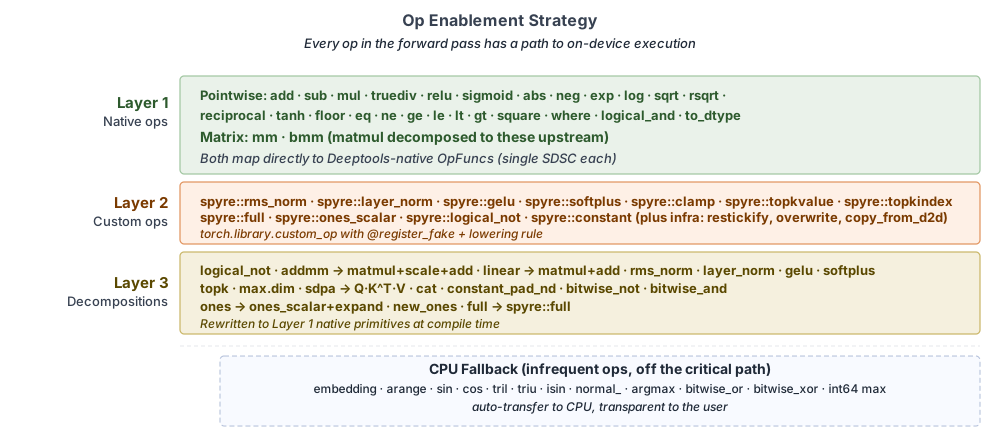
Figure 5: The three layers of op handling on Spyre, along with a CPU fallback path for the long tail. Decompositions rewrite ATen ops into native ops or custom ops. Custom ops lower to SuperDSCs built from native OpFuncs.
We validate at four levels. The first level runs the PyTorch upstream test suite, which includes
test_view_ops and the OpInfo-based tests through instantiate_device_type_tests, directly
against the spyre device. This is the most important compatibility signal. If the PyTorch
framework agrees that Spyre tensors behave correctly, the integration is sound at the API level.
We maintain an allowlist of which test variants pass and we update it with each PR. The second
level tests individual ops against CPU reference outputs in test_inductor_ops.py. The third
level tests transformer building blocks, such as attention heads, FFN, and normalization, as
composed subgraphs in test_building_blocks.py. The fourth level tests full model forward
passes with real Granite weights against YAML-specified tolerance profiles in
test_model_ops.py. All four levels run in CI on every pull request.
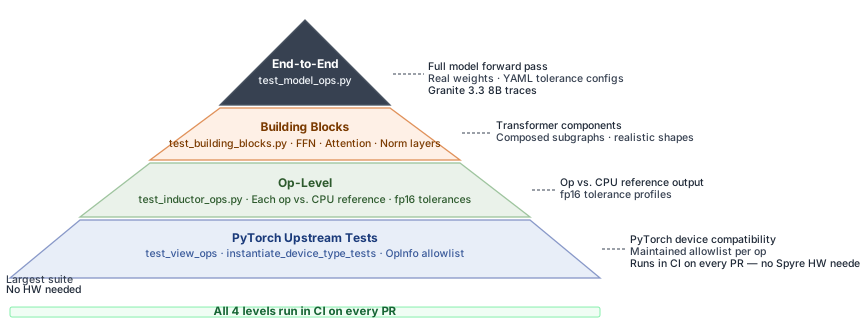
Figure 6: The four validation levels run in CI on every PR. All four tiers currently require Spyre hardware. There is no emulated mode yet.
What we learned
The extension points exist. These are PrivateUse1, the scheduler pass hooks, the TorchInductor
backend registration, and a custom TensorImpl. We built everything out-of-tree, but we still
monkey-patch a small number of internal APIs where the extension points are incomplete. The
patches fall into two groups: import-time patches in
_monkey_patch.py
that extend Dynamo guards and the FxGraph cache key to track SpyreTensorLayout plus a few
torch.Tensor and torch.empty overrides for tiled-layout awareness, and compilation-scoped
patches in
_inductor/patches.py
that adjust the computation-dtype map, fusion patterns, the scheduler-passes injection, and a
realization heuristic. Each patch corresponds to a missing upstream extension point.
The device registration layer is well documented. torch.accelerator and OpenReg give a clear
starting point. The deeper hooks, which are the scheduler passes and codegen, are less well
documented. For those, we spent a lot of time reading the source code of other backends to
figure out the patterns.
Staying out-of-tree was worth the discipline it imposed. Every time we were tempted to edit a core file directly, the constraint pushed us toward finding the proper hook instead. That is not a comfortable way to develop. It did give us independent release cadence, clean CI, and no risk of breaking PyTorch for anyone else.
The stride model gap is real and unsolved at the framework level. FixedTiledLayout is a local
fix. Any scratchpad-based accelerator will run into the same mismatch, and we think a
generalized version should live in Inductor.
Covering operations was also a long task. We had to handle edge cases in dtype promotion, layout propagation, view semantics, and error messaging across dozens of operations.
What is next
KTIR. The Kernel Tile IR specification is published as RFC 0682 and two open-source companion projects are up: a CPU interpreter at torch-spyre/ktir-cpu and an MLIR parser at torch-spyre/ktir-mlir-frontend. The remaining work is the backend lowering path that lets KTIR replace SuperDSC in the production flow.
Scratchpad optimization. The scratchpad planner is in-tree under
torch_spyre/_inductor/scratchpad/. The default greedy solver has shipped along with first-fit
and best-fit variants, an in-place reuse pass, a clone-input pre-pass, and a multi-core layout
mode. A graph-aware co-optimisation pass that aligns work-division splits with LX placement is
in proof-of-concept form. See Scratchpad planning.
Distributed inference. The spyreccl torch.distributed backend is implemented under
csrc/distributed/. Synchronous send, recv, broadcast, barrier, gather, allgather,
reduce, and allreduce work today. The remaining work is async support and the missing
collectives (scatter, reduce_scatter, alltoall). See
Runtime — Multi-card and distributed execution.
Profiling. torch.profiler integration via ProfilerActivity.PrivateUse1 is implemented
in the in-progress SpyreActivityProfiler Kineto bridge. The memory APIs
(torch.spyre.memory.memory_allocated and friends) are available today, and
aiu-trace-analyzer post-processes traces with PT-utilisation metrics. The
profiling RFC 0601
covers the full plan; current state is summarised on the
Profiling page.
Broader model and serving coverage. Llama 3.1 8B, vision models, and speech models are next. We are also integrating with vLLM as a platform plugin alongside CUDA and ROCm.
Upstream contributions. We plan to contribute a generalized FixedTiledLayout for Inductor,
OpenReg primitives for standardized out-of-tree backend testing, and documented CI patterns for
hardware teams that follow us.
Getting started
Torch-Spyre is available for users who have access to IBM Spyre hardware. Install from source.
git clone https://github.com/torch-spyre/torch-spyre
cd torch-spyre && pip install .
PyPI distribution (pip install torch-spyre) is coming soon.
Documentation: torch-spyre.readthedocs.io
Appendix: extension point reference for out-of-tree PyTorch backends
For teams that are building out-of-tree PyTorch backends, the tables below list every hook we used. The tables are organized by the challenge that each hook addresses.
Challenge 1: device registration (PrivateUse1)
Component |
PyTorch Hook |
Purpose |
Key Detail |
|---|---|---|---|
|
PrivateUse1 |
Makes |
Must be called before any device use; rewires dispatch tables and |
|
PrivateUse1 |
Attaches the Python device module |
Provides |
|
|
Device context management |
Registered via |
|
|
Custom device memory allocator |
Registered for |
|
|
Carries tiled layout metadata alongside the PyTorch tensor |
Adds |
|
|
Reports device availability and primary context status |
Queried by PyTorch runtime during device enumeration |
|
|
Asynchronous execution and CPU↔Spyre overlap |
Implements |
|
|
Multi-card collective communication via |
|
Initialization is lazy and thread-safe. Importing torch_spyre registers the device name and
module. flex::initializeRuntime() starts only on the first device use.
Challenge 2: tiled tensor layout (FixedTiledLayout)
Component |
PyTorch Hook |
Purpose |
Key Detail |
|---|---|---|---|
|
|
Bridges the PyTorch stride model and Spyre tiled memory |
Carries a |
|
|
Converts |
Topological traversal of IR operations. Pointwise ops inherit the input layout. Matmul and reduction require special handling for the contracted output dimension. External kernels use a generic stick format. |
|
|
Partitions iteration dimensions across 32 cores at compile time |
Constrained by |
Why the scheduler phase. Tiled layouts must be resolved before codegen because they are needed for memory planning and core work division. Propagating through Dynamo and FakeTensor would require invasive core changes. Deferring to codegen is too late.
Challenge 3: Inductor backend for dataflow compilation
Component |
PyTorch Hook |
Purpose |
Key Detail |
|---|---|---|---|
|
Context manager |
Activates all Spyre-specific Inductor configuration |
Registers decompositions, lowerings, |
|
Inductor backend scheduling class |
Decides how to group and order operations |
Replaces Triton scheduling. Registered at import time. |
|
Inductor backend codegen class |
Generates the Python wrapper that allocates tiled buffers and launches kernels |
Calls |
|
Inductor device op overrides |
Device-specific operation implementations |
Registered at import time alongside the scheduling and codegen classes |
|
Custom codegen pipeline |
Produces the SuperDSC JSON IR per scheduled node |
|
Challenge 4: op coverage
Mechanism |
PyTorch Hook |
Purpose |
Key Detail |
|---|---|---|---|
Native ops (Deeptools-supported) |
Direct mapping to OpFuncs |
Pointwise and matrix ops supported natively by the hardware |
Pointwise: |
|
Custom op registration |
Layer 3 normalization, activation, and ops that need a single named lowering target |
Each op requires |
Decompositions |
Registered in |
Layer 4 ops not natively available |
|
CPU fallback (auto-transfer) |
PyTorch fallback dispatch |
Infrequent ops that are off the critical path |
|
Profiling
Component |
PyTorch Hook |
Purpose |
Key Detail |
|---|---|---|---|
|
|
Per-device memory queries |
|
|
Standalone CLI / sampler |
Power, thermal, PT-utilisation, DDR / PCIe / RDMA bandwidth |
Available in PF and VF mode (Z/LinuxONE rollout in progress for VF). Public release tracked in #1335. |
|
Trace post-processor |
Adds derived metrics (PT-Util %) to Chrome / Perfetto traces |
Available with some known gaps. |
|
|
Device-side kernel timing into |
In progress in #1856. The full design is in profiling RFC 0601. |
Acknowledgments
This work is a collaboration across multiple teams at IBM Research. We thank the PyTorch team for building the extensibility mechanisms that made this possible without forking the core. We also thank the broader community for the reference implementations (Ascend NPU, Intel GPU, and OpenReg) that helped us understand what an out-of-tree backend could look like in practice.